Playbooks
AI voice agents for hotels: a practical guide for Indian hoteliers
How an AI voice agent for hotels in India answers everyday guest calls, which calls should go to your team, and how to start safely and measure it.

An AI voice agent for hotels in India works best on the everyday calls: room availability, booking questions, check-in and check-out times, directions, amenities and late arrival notes. These calls come in all day and are mostly the same few questions. Special requests, complaints and group bookings still need your team, with the full conversation already in front of them.
This guide covers where an AI agent fits, what a good call sounds like and how the handoff works. Then it looks at how guests in India call, and how to start.
Where does an AI voice agent fit in an Indian hotel’s calls?
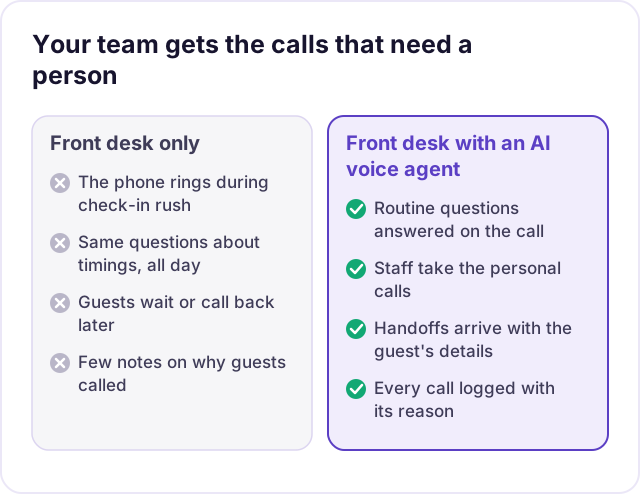
Think of it as an AI receptionist for your hotel that only takes the routine calls. It picks up, answers the question from your hotel’s own information, and passes anything personal to your team.
Many calls to a hotel are one of a handful of questions. Is a room free on Saturday? What time is check-out? Is breakfast included? How do I get there from the station? Each one is quick, but together they pull your front desk away from the guests standing in front of it.
| Call | Who should take it |
|---|---|
| Room availability and rates | AI voice agent |
| Check-in and check-out times, early arrival | AI voice agent |
| Directions, parking, pickup | AI voice agent, with a map link on WhatsApp |
| Amenities: breakfast, pool, Wi-Fi, pets | AI voice agent |
| Late arrival note on an existing booking | AI voice agent, logged on the booking |
| Simple new booking | AI voice agent, if it can see live availability |
| Anniversary, birthday, dietary or medical | Your team |
| Complaint or upset guest | Your team, straight away |
| Group booking, wedding or custom quote | Your sales or reservations team |
The point isn’t to take people off the phone. It’s to give your team fewer “what time is check-out” calls and more time for the calls that need them.
What happens on an AI guest call?
A good guest call is short, polite and ends with something done: a question answered, a note on the booking, or a handoff to the right person.
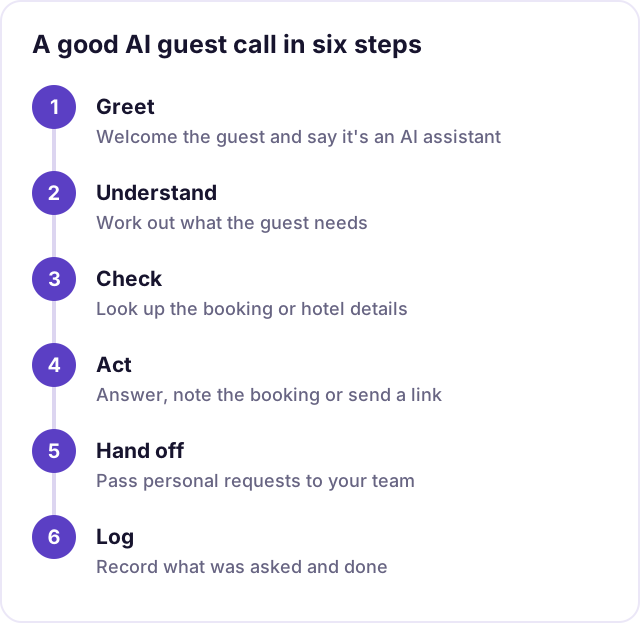
Here’s what that can sound like for a guest who calls in Hindi, with English in brackets. The hotel and guest are made up.
Agent: Namaste, ABC Residency mein aapka swagat hai. Main hotel ki AI assistant bol rahi hoon. Bataiye, main kya madad kar sakti hoon? (Hello, welcome to ABC Residency. I’m the hotel’s AI assistant. How can I help?)
Guest: Aaj raat ki booking hai, Neha Iyer ke naam se. Train late hai, hum raat 11:30 tak pahunchenge. (I have a booking for tonight, under Neha Iyer. The train is late, we’ll reach by 11:30 pm.)
Agent: Koi baat nahi, Neha ji. Maine booking par raat 11:30 ka late arrival note kar diya hai. Aapka room hold rahega. (No problem. I’ve noted an 11:30 pm arrival on your booking. Your room will be held.)
Guest: Station se hotel kaise aayein? (How do we get to the hotel from the station?)
Agent: Hotel station se lagbhag 4 kilometre hai. Main WhatsApp par map link bhej deti hoon. (The hotel is about 4 km from the station. I’ll send a map link on WhatsApp.)
Guest: Aur kal hamari anniversary hai. Kuch special ho sakta hai? (Also, tomorrow is our anniversary. Can you arrange something special?)
Agent: Bahut badhai ho. Iske liye main aapko hamari front office team se jodti hoon. Aapki booking aur ab tak ki baat unke saamne hogi. (Congratulations. Let me connect you to our front office team for this. They’ll have your booking and our conversation in front of them.)
The first two requests are routine, so the agent handles them. The third is personal, so it goes to a person, and the guest doesn’t have to repeat anything.

Which calls should go to your team, and how does the handoff work?
Anything personal, emotional or worth negotiating goes to a person. A bad handoff makes the guest tell the whole story again, so give your team the context before they say hello.
Hand these calls to your team:
- Special occasions: anniversaries, birthdays, honeymoons, surprises.
- Health and diet: allergies, Jain or other dietary needs, accessibility, medical needs.
- Complaints: an upset guest, a billing dispute or a problem during the stay. Send these straight away, without trying to solve them first.
- Groups and quotes: weddings, corporate offsites, ten rooms for a family function, long stays.
- Anything the agent isn’t sure about. A wrong answer costs more than a transfer.
When the call reaches your team, the person picking up should see four things:
- Who the guest is, and their booking.
- What the guest asked for.
- What the agent already said or did.
- Why the call was handed over.
Test this before you go live. Call in yourself as a guest with an anniversary request and check what your front desk sees.
Also decide what happens when no one is free. The agent can take a message and a good time to call back, and your team returns the call. That’s far better than a phone that rings out.
How do guests in India call hotels?
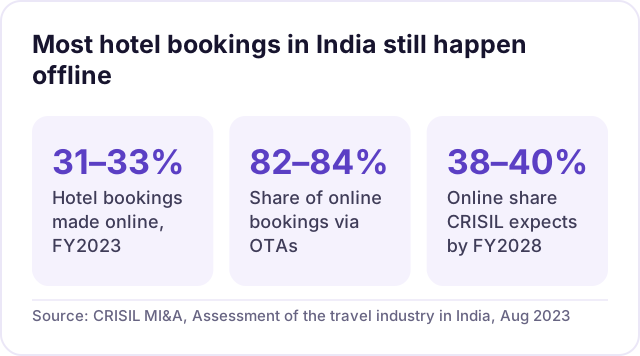
Most hotel bookings in India still happen offline, and offline includes phone calls. Only 31–33% of hotel bookings were made online in FY2023, according to CRISIL’s assessment of India’s travel industry. CRISIL counts phone calls and walk-ins as offline bookings, and says tier-II and tier-III cities largely still book offline.
Calls come from three kinds of guests:
- Direct callers who found your number on Google Maps, a sign or a friend’s tip, and want to ask before they book.
- Guests who booked on an online travel agency (OTA) such as MakeMyTrip or Booking.com. CRISIL says OTAs take 82–84% of online hotel bookings. These guests often call the property anyway, for directions, early check-in, meal timings or parking. We haven’t seen public data on how many do, but most front desks will recognise it.
- Guests on the way, calling from a train, a highway dhaba or the airport with a late arrival or a “where exactly are you?”
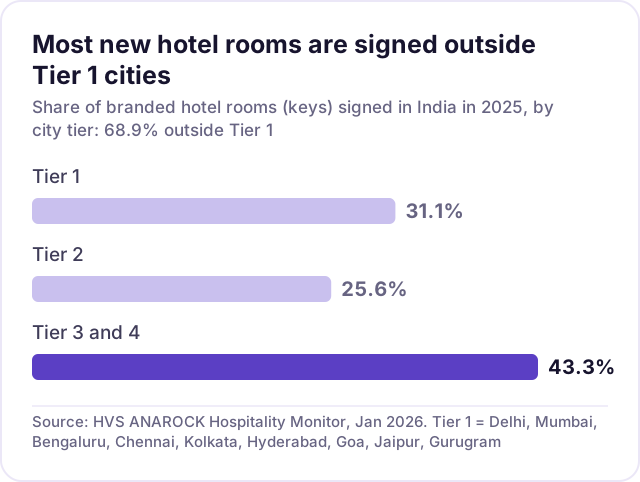
New hotel supply is also moving beyond the big cities. About 69% of branded hotel rooms signed in 2025, for future opening, were outside Tier 1 cities, according to the HVS ANAROCK Hospitality Monitor.
Answer in the guest’s language
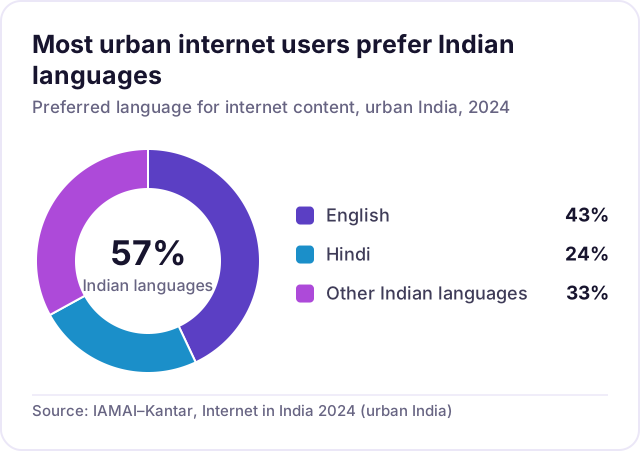
Guests call in the language they’re comfortable in, and many switch between Hindi and English in the same sentence. Hindi is the mother tongue of 43.63% of Indians, per the Census of India 2011, a count that includes mother tongues grouped under Hindi, such as Bhojpuri. Even among urban internet users, 57% prefer content in Indian languages over English, according to IAMAI and Kantar’s Internet in India 2024.
MagickVoice agents speak 25+ languages, including 10+ Indian languages with native accents, such as Hindi, Tamil, Telugu, Kannada, Malayalam and Marathi. A heritage hotel in Jaisalmer might want Hindi first, with English for guests from abroad. A homestay in Coorg might want Kannada and English.

How do you measure whether it’s working?
Compare against how your calls are handled today, not against a guess. Note your current numbers for two weeks before you go live, then track the same numbers after.
| Metric | What it tells you |
|---|---|
| Calls answered | How many guest calls get picked up at all |
| Questions resolved | How many calls end without needing a person |
| Bookings completed | How many reservation calls turn into a confirmed stay |
| Handoff rate | How often the agent passes a call to your team |
| Repeat calls | Whether guests call back about the same thing |
| Guest feedback | What guests say in reviews and post-stay surveys |
Watch handoffs and repeat calls from day one. If either is high, the agent is probably missing information, like your pet policy or the new pickup timing. That’s usually a quick fix once you spot it.
MagickVoice shows sentiment, intent and KPI analytics on every call in a real-time dashboard. The intent data tells you why guests call, which is useful even beyond the AI agent. If half your calls ask about parking, put it on your booking confirmation.
How do you get started?
Start with one type of call that’s easy to get right, then widen slowly.
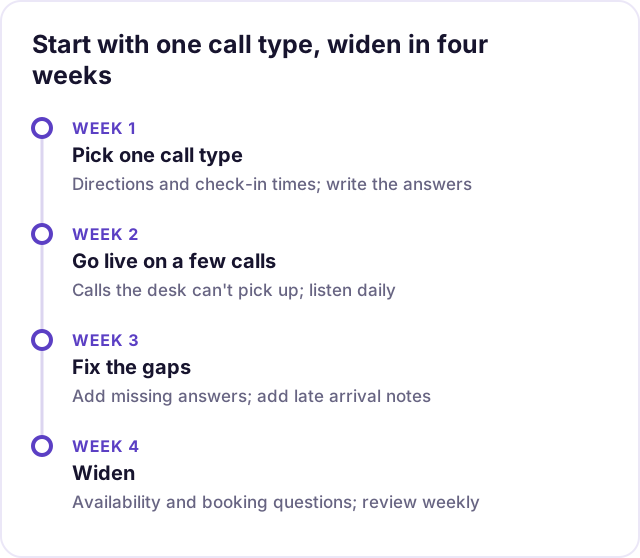
- Write down the 20 questions guests ask most, with your hotel’s exact answers.
- Pick one type of call to start, such as directions and check-in times.
- Set the handoff rules: which requests go to which person, and what happens when no one is free.
- Go live on the calls your desk can’t pick up, and listen to the recordings every day for the first two weeks.
- Fix the answers and add late arrival notes, then availability and booking questions.
MagickVoice is no-code. You describe the agent in plain language or start from one of 50+ industry templates, and setup takes about five minutes. Building the agent is quick. The four weeks are for getting the answers right. It’s free to start, then pay-as-you-go.
A note on outbound calls
This guide is about calls guests make to you. If you also want the agent to call guests, for example to confirm arrival times, keep those calls about the booking.
Adding an offer like a spa package can make it a promotional call. Promotional calls must come from a 140-series number, the prefix TRAI reserves for them, and respect DND (the Do Not Disturb registry). TRAI’s September 2026 amendment also requires businesses to declare AI voice calls, and the numbers they’ll use, to their telecom provider in advance.
You remain responsible for consent, permitted calling hours and telling guests they’re speaking to an AI agent. Guest names, numbers and booking details are personal data too, so check how any vendor stores call data before you sign up.
Want to hear one first? Call Aria, MagickVoice’s own AI voice agent, on +91-80653-90179, 24/7. Aria speaks English, Hindi, Tamil, Telugu, Kannada, Malayalam and Marathi. Then see how customer support calls and booking calls work on MagickVoice, or check the product FAQ.
For more, read how an AI voice agent differs from an IVR and our guide to AI voice agents for loan collections.
Want to hear an AI voice agent for yourself? Call Aria, our own agent, on +91-80653-90179 — any time, in 7 languages.